
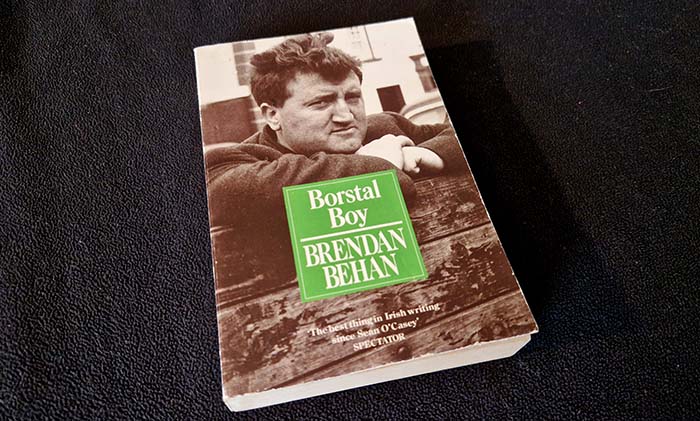
Book Discussed: Borstal Boy by Brendan Behan
Book club Zoom meeting: 19 Nov 2024
Our book club kicked off with a flying start. Borstal Boy is a classic in the canon of modern Irish literature, an enjoyable accessible read and redolent with queer themes. It received a universally enthusiastic reception from our reading group.
The book was published in 1959, twenty years after the events it describes and only five years before the author’s untimely death. It is Behan’s account (perhaps somewhat romanticised) of his imprisonment following his arrest in Liverpool as a recently arrived teenaged IRA saboteur. The first half of the book has some dark and challenging moments as it covers his initial entanglement with the English justice system being moved around among various grim prisons and courts over several months. The mood then lightens considerably as Behan is assigned to a prototype Borstal work-camp for the remainder of his three year term. The entire story is told with compelling charm and vivacity. Comedic aspects are emphasised over tragic ones at every opportunity. Indeed it more often reads like a “boys’ own” adventure story than a gruelling prison memoir.
The readers in our book group all commented on the strong theme of camaraderie among the Borstal inmates that permeates Behan’s account of his incarceration. In particular, Behan formed some special strong friendships and these were often fairly obviously coded physical and emotional relationships. In the 1950s, he could not have published a memoir that was explicit about such things but he signals his meaning very clearly to any careful reader. There is a great deal of affection expressed towards his fellow inmates, mostly working class English lads with whom he realises he has much in common despite his nationality and politics. Most of the guards and administrators are also treated more gently than might have been expected, certainly those in the Borstal institution. Behan is universally known as Paddy throughout his time inside but he accepts this with the good humour which characterises all of his interactions.
As well as the coded queer relationships that Behan unapologetically describes, our reading group also observed how he grows and matures during the story. He clearly emerges as a leader among his peers in the Borstal due to his intelligence and personability. He leaves Borstal wiser, more grown up and challenging many of his old assumptions (particularly his idealistic Republicanism). Despite the sugar coating and sentimentality that clearly infuses Behan’s recollection of his Borstal days, it never rings untrue and is never less than compelling. All felt that it was a valuable testament of an important time in the evolution of attitudes both towards LGBTQ people and relationships and towards Irish people in Britain. And a great read.
 London Irish LGBT Network